Once I learned about giftedness and twice-exceptionality after my children received their diagnoses, I began recognizing attributes of both in myself and other family members. Coming from a culturally diverse background, it’s fair to say that challenges related to neurological and cultural differences have affected at least three generations of my family.
Having immigrated to the U.S. in their forties, my parents struggled with English and were often perceived as less intelligent because of their language difficulties. When I arrived in the U.S. as a teenager, I experienced a cultural shock and academic challenges stemming from differences between American and Soviet educational systems. My children, who are officially diagnosed as twice-exceptional or 2e (Baum et al., 2017), and are also bilingual and bicultural – now sometimes described as thrice-exceptional or 3e (Davis & Robinson, 2018) – faced biases related to both their neurological and cultural quirks.
Their neuropsychological evaluations were conducted solely in English, disregarding the knowledge and vocabulary they had acquired in Russian. Meanwhile, my daughter was advised to abandon studying Russian after being diagnosed with dyslexia, contrary to research studies showing no negative effects of bilingualism in dyslexia (Vender & Melloni, 2021) and even evidence of an advantage (Vender et al., 2021). My son, on the other hand, struggled with essay questions on standardized tests, as the prompts often relied on interpreting social interactions—tasks that are not particularly autism-friendly.
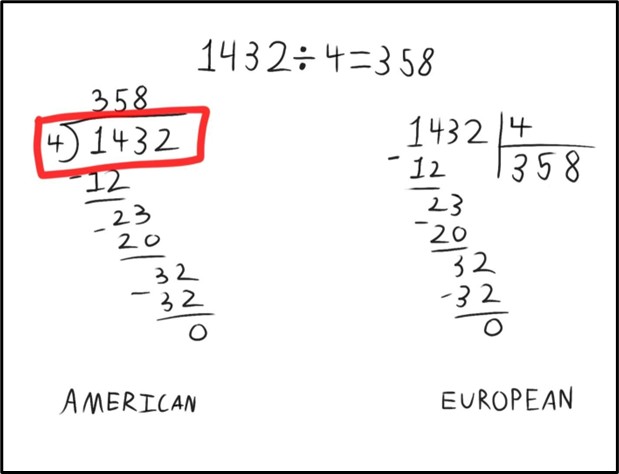
A couple of years ago, while teaching my daughter long division—we had chosen to homeschool after realizing that mainstream education was not a good fit for our children—I had an epiphany. I discovered that the American way of doing long division is the mirror image of how I was taught in school in Kyiv. That realization explained a lot. My earlier encounter with long division, which I am about to share, might have completely changed the course of my life.
My family arrived in the U.S. in late August, just as the new school year was about to begin. I was about to enter my junior year, and on the advice of my parents’ friends, we looked into Lowell High School, a magnet school in San Francisco. To enroll, I had to take the entrance exams. Two days after setting foot on American soil for the first time, I went in to be tested in English and math. I was nervous, especially about English. Although I had studied it as a foreign language at my school in Kyiv, I had never interacted with native speakers before and could barely distinguish individual words in the stream of American speech around me. I was also anxious about math, not knowing what to expect and frantically reviewing derivatives of trigonometric functions before the exam. However, the math portion turned out to be surprisingly simple—or so I thought. It only required adding, subtracting, multiplying, dividing, and finding percentages. I sighed with relief and finished it easily, without any trouble.
To my utter shock, when the results came back, I found out that I had made four mistakes on the math portion! I could not believe it! Everything had seemed so straight forward. When my parents and I asked for more details and clarification, we were told that I had gotten all four long division problems wrong. And that was that – Lowell High was out of question.
 Graphic by Yulia O’Neil
Years later, while teaching long division to my daughter, I finally realized what had happened. I had gotten those four problems on an entrance exam wrong because I had misread how the problems were written, and saw them in the way I was used to. I assumed, as I had been taught in Kyiv, that the dividend was on the left and the divisor on the right (red box in the sample above). Whereas in the U.S. it is the other way around. My misunderstanding led me to choose the wrong options for my answers on all four multiple-choice questions.
What I am getting at is this: oftentimes, we are not even aware of the issues, problems, injustices, and biases we experience. We take them for granted and concede to them because we don’t realize that there is an explanation or simply another way. I wonder how many other culturally diverse families live through similar experiences without ever realizing their impact. As advocates for our children and families, our role is to shed light on these unseen biases and misunderstandings, and help others see that there is an explanation and that there is another way.
References
Baum, S. M., Schader, R., & Owen, S. V. (2017). To be gifted and learning disabled: Strength-based strategies for helping twice-exceptional students with LD, ADHD, ASD, and more (3rd edition). Routledge.
Davis, J. L., & Robinson, S. A. (2018). Being 3e, a new look at culturally diverse gifted learners with exceptional conditions: An examination of the issues and solutions for educators and families. In S. B. Kaufman (Ed.), Twice exceptional: Supporting and educating bright and creative students with learning difficulties (1st ed., pp. 278–289). Oxford University Press.
Vender, M., Hu, S., Mantione, F., Savazzi, S., Delfitto, D., & Melloni, C. (2021). Inflectional morphology: Evidence for an advantage of bilingualism in dyslexia. International Journal of Bilingual Education and Bilingualism, 24(2), 155–172. https://doi.org/10.1080/13670050.2018.1450355
Vender, M., & Melloni, C. (2021). Phonological Awareness across Child Populations: How Bilingualism and Dyslexia Interact. Languages, 6(1), 39. https://doi.org/10.3390/languages6010039
 Yekaterina (Katrina) O’Neil is a homeschooling mom by day, a doctoral student by night, and a cybersecurity professional by trade. A mother of two twice-exceptional children in middle and high school, she began homeschooling after public school was not a fit. She is pursuing a doctorate at Bridges Graduate School of Cognitive Diversity in Education to support neurodivergent learners. Born in the former Soviet Union, she advocates for culturally diverse twice-exceptional individuals through writing, research, speaking, consulting, and coaching.
